
How to Integrate Contactless Vitals Into CCM Workflows
A research-based look at how teams integrate contactless vitals into CCM workflows, from monthly outreach and triage to documentation and chronic care follow-up.
How to Integrate Contactless Vitals Into CCM Workflows
Integrate contactless vitals CCM workflow planning is really a staffing and process question disguised as a technology question. Chronic care management programs already know they need regular patient contact, cleaner documentation, and better visibility between visits. What they do not always know is how to add fresh physiologic data without mailing more hardware, creating another dashboard nobody trusts, or making older patients do one more thing they will stop doing by month two. That is why contactless vitals are getting real attention in CCM. They offer a lower-friction way to bring current patient signal into a monthly care-management model that was built around steady follow-up rather than one-time readings.
"People living with multiple chronic conditions account for 71% of all health care spending and 93% of Medicare spending." — Agency for Healthcare Research and Quality, Multiple Chronic Conditions Chartbook
Why integrate contactless vitals into CCM workflows at all
CCM is already structured around repeated non-face-to-face management. CMS's Chronic Care Management guidance says standard CCM applies to patients with two or more chronic conditions expected to last at least 12 months or until death and requires at least 20 minutes of qualifying clinical staff time per calendar month for CPT 99490. In other words, the workflow already exists. The open question is what kind of patient signal makes those monthly minutes more useful.
That matters because the chronic populations enrolled in CCM are rarely stable in a tidy way. A patient with heart failure can start drifting before they report symptoms. A patient with COPD may show respiratory change before they request help. A patient with diabetes and behavioral-health overlap may not miss the monthly call, but their baseline may still be moving in the wrong direction. If the staff only have symptom recall and a diagnosis list, they are often reacting late.
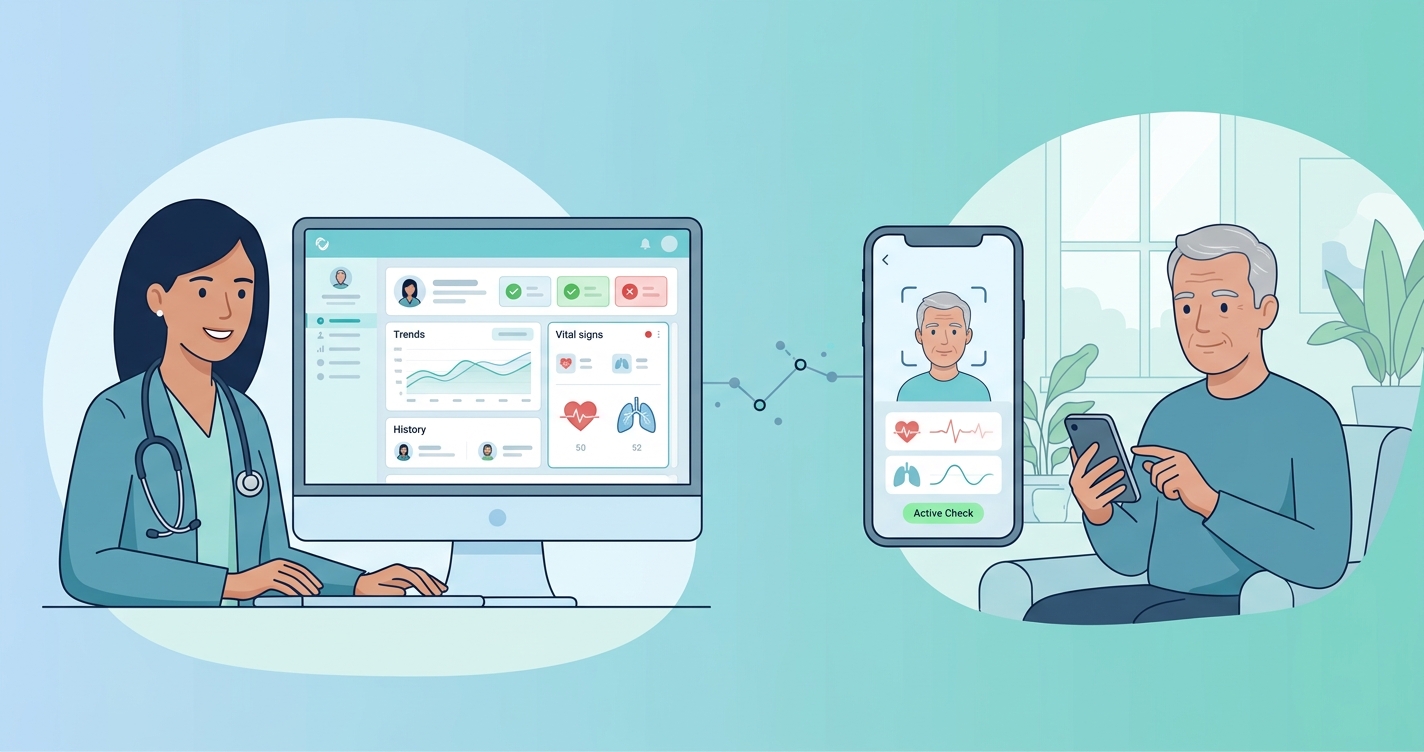
Contactless vitals fit here because they can create a brief, repeatable check-in on a phone, tablet, or kiosk without adding another wearable. The promise is not that a camera scan replaces every device in chronic care. It is that low-burden signal can make monthly CCM outreach more specific, more timely, and easier to scale across a broad panel.
| CCM workflow question | Traditional outreach-only model | CCM workflow with contactless vitals |
|---|---|---|
| What starts the monthly review? | Scheduled call, note review, and patient recall | Scheduled review plus fresh physiologic check-in |
| What data does staff use? | Symptoms, diagnoses, prior utilization, med list | Symptoms, prior risk, and current vital-sign trend data |
| Which patients get prioritized? | Patients on static call cadence | Patients whose baseline or adherence changed |
| What creates friction? | Manual outreach with little context | Onboarding and workflow integration, but less hardware burden |
| What supports documentation? | Time logs and care-plan updates | Time logs, care-plan updates, and current monitoring context |
| What scales better across large CCM panels? | More staff time per patient | Better triage when current signal is available |
The practical advantage is not glamorous. Staff can start the monthly interaction with a reason for the conversation.
What integration looks like inside a real CCM workflow
The phrase "integrate contactless vitals" can sound bigger than it is. In most CCM programs, integration succeeds when it does four plain things well.
- It places the check-in inside the monthly care-management rhythm instead of outside it.
- It compares the patient's current status with baseline rather than treating one reading as the whole story.
- It routes concerning changes to the nurse, care manager, or physician who can act on them.
- It leaves behind documentation that actually supports the care plan and the billed CCM work.
That sounds obvious, but it is where many remote-care programs break down. Mariana Peyroteo of NOVA University Lisbon and colleagues reported in a 2021 JMIR mHealth and uHealth systematic review that integration into existing systems and workflows was the main recurring implementation barrier in primary-care remote monitoring programs. The problem was not a lack of sensors. It was operational fit.
For CCM operators, that lesson matters more than any one device spec. A contactless workflow only helps if it sits in the same path as consent, monthly time tracking, care-plan review, outreach, escalation, and documentation.
1. Enrollment should begin with the chronic-care use case
The best CCM programs do not enroll patients into monitoring because monitoring sounds modern. They enroll patients because the workflow solves an existing problem.
Common examples include:
- heart failure patients who need closer follow-up after discharge or medication change
- COPD patients whose respiratory stability matters between visits
- diabetes patients with poor engagement or overlapping cardiovascular risk
- multimorbid older adults who are unlikely to keep up with another device
This is where the getvitalsscan.com niche is especially relevant. Chronic disease monitoring without wearables is not just a product angle. It is a patient-adherence strategy.
2. The scan has to happen close to the monthly CCM touchpoint
Some programs ask patients to complete a brief camera-based scan before the scheduled CCM interaction. Others do it during a guided outreach session. Either way, the timing matters. If the signal is too old, the staff will ignore it. If the process is too complicated, patients will skip it.
A good integration pattern usually has a short window:
- the patient completes a quick check-in before the monthly review
- the care coordinator sees whether the result looks broadly stable or changed from baseline
- the monthly conversation uses that context to guide questions and next steps
This is why contactless measurement is interesting for chronic care buyers. A 2024 Frontiers in Bioengineering and Biotechnology review by Wei Chen, Zhe Yi, Lincoln Jian Rong Lim, Rebecca Qian Ru Lim, and colleagues described deep-learning and remote photoplethysmography methods for contactless physiologic measurement, including heart rate, respiratory rate, heart rate variability, skin perfusion, and related signals. For CCM teams, the technical detail matters less than the operational implication: common cameras may be able to produce usable signal without another hardware deployment cycle.
3. Staff should review change, not chase isolated numbers
Most successful chronic-care workflows are built around trend and context.
A nurse or care coordinator is usually asking:
- Is this patient's resting pattern materially different from their usual pattern?
- Did adherence drop off after a stretch of reliable check-ins?
- Has respiratory rate, heart rate, or overall stress pattern shifted enough to justify a call?
- Did this change happen after discharge, medication adjustment, or a missed PCP follow-up?
That kind of review fits the real economics of CCM. Charles Stoecker of Tulane University and colleagues reported that non-face-to-face chronic care management for Medicare beneficiaries with type 2 diabetes was associated with fewer monthly hospital admissions and fewer emergency department visits, alongside more outpatient encounters. The value was not passive data collection. It was that steady management changed where care happened.
4. Escalation has to stay inside the care-management workflow
This is the step buyers sometimes underestimate. If contactless vitals produce signal but nobody owns the response, the program becomes another source of noise.
A workable model usually has simple routing logic:
- stable trend: document, reinforce, continue standard follow-up
- mild change from baseline: ask focused questions, confirm medications, review symptoms
- concerning change or repeated missed check-ins: escalate to nurse review or physician-directed follow-up
- post-discharge or high-risk instability: move the patient into a tighter outreach cadence
That is not a tutorial. It is the operating reality. Contactless data has to feed the care plan.
Where contactless vitals fit best in CCM programs
Monthly CCM check-ins
This is the most natural fit. Standard CCM already depends on a repeatable monthly touchpoint. Contactless vitals can make that contact more informed without changing the core billing logic.
Post-discharge chronic follow-up
Patients moving from hospital to home often show subtle drift before they describe a problem clearly. A lighter-weight check-in can help staff decide who needs a call now instead of next week.
Multimorbidity management
Patients with two, three, or four chronic conditions rarely fit clean disease-specific workflows. A single low-friction physiologic check-in is often more realistic than stacking multiple devices and expecting reliable adherence.
Device-fatigued populations
This may be the most overlooked use case. Many older adults do not reject monitoring because they reject care. They reject one more charger, one more setup task, and one more routine. Contactless workflows matter because they reduce that burden.
Readers looking at adjacent chronic-care topics may also want our posts on How CCM Programs Use Contactless Vitals for Monthly Check-Ins and How ACOs Monitor High-Risk Patients Between Visits.
Current research and evidence
Several sources make the case for integrating contactless vitals into CCM workflows more concrete.
- CMS's MLN guidance on Chronic Care Management makes clear that standard CCM revolves around monthly non-face-to-face management for patients with multiple chronic conditions and at least 20 minutes of qualifying staff time. That monthly rhythm is exactly where a low-friction check-in can add value.
- Donato Giuseppe Leo, Benjamin J. R. Buckley, Mahin Chowdhury, Stephanie L. Harrison, Masoud Isanejad, Gregory Y. H. Lip, David J. Wright, and Deirdre A. Lane reported in a 2022 Journal of Medical Internet Research systematic review and meta-analysis that interactive remote patient monitoring was associated with lower mortality and improvements in blood pressure and glycated hemoglobin, with generally good satisfaction and adherence.
- Mariana Peyroteo and colleagues found in 2021 that remote monitoring programs in primary care repeatedly struggled with integration into existing systems and workflows, which is a reminder that operational fit matters as much as measurement capability.
- Wei Chen and colleagues' 2024 review shows why contactless measurement keeps gaining attention: camera-based methods now span heart rate, respiratory rate, heart rate variability, and related physiologic estimation without direct-contact sensors.
- AHRQ's chartbook remains the economic backdrop for all of this. Chronic care programs are managing the part of the population where a small workflow improvement can affect a very large share of spending.
The literature does not say every CCM program should throw out devices and go camera-only. It says low-friction monitoring has a better chance of sticking when it works with the care team's existing model.
The future of integrate contactless vitals CCM workflow design
The next stage of CCM will probably look less like separate product categories and more like a blended workflow. Some patients will still need traditional devices. Some will do fine with monthly or near-daily contactless check-ins. The winning programs will be the ones that know which model belongs to which patient.
A few shifts already look likely.
- Monthly CCM interactions will become more baseline-aware and less generic.
- Programs will reserve mailed hardware for the patients who truly need it.
- Contactless signal will matter most where it improves staff triage, not where it generates the most data.
- CCM, APCM, and adjacent remote-care workflows will continue to overlap as providers look for simpler operating models across chronic populations.
CMS's 2025 Physician Fee Schedule final rule, which introduced APCM codes G0556, G0557, and G0558, points in the same direction. The market is rewarding longitudinal care management, not isolated readings. Contactless vitals fit when they strengthen that longitudinal model.
Frequently Asked Questions
What does it mean to integrate contactless vitals into CCM workflows?
It means placing a brief camera-based vital-sign check-in inside the monthly chronic care management process so staff can review current patient status, update the care plan, and route follow-up more intelligently.
Does CMS require vital signs to bill CCM?
No. CCM billing is built around eligible chronic conditions, patient consent, care-plan management, and qualifying monthly non-face-to-face staff time. Programs add contactless vitals because it can make the workflow more informative, not because it is a billing requirement by itself.
Which CCM patients are the best fit for contactless vitals?
Programs often start with patients who have heart failure, COPD, diabetes, or multiple chronic conditions, especially when those patients are less likely to stay engaged with wearable or device-heavy monitoring.
Why is workflow integration more important than the measurement feature list?
Because chronic care teams only benefit from monitoring data when it feeds outreach, triage, escalation, and documentation. If the signal sits in a separate workflow, it usually gets ignored.
For chronic care operators, the question is not whether more data sounds useful. It is whether the data makes the monthly CCM workflow easier to run and easier to act on. Contactless vitals are interesting because they can do exactly that for the right patients: create current signal without adding more device fatigue. Solutions like Circadify's chronic care management offering are being built around that lower-friction model, giving care teams another option for chronic follow-up between visits.