
Post-Discharge Monitoring: How to Prevent 30-Day Readmissions
An analysis of how post-discharge monitoring helps care teams prevent 30-day readmissions through follow-up, daily vitals data, and better triage.
Post-Discharge Monitoring: How to Prevent 30-Day Readmissions
Post discharge monitoring prevent readmissions is one of those phrases that sounds operational until you attach real stakes to it. For chronic care organizations, ACOs, and hospital-at-home teams, the first 30 days after discharge are where medication confusion, missed follow-up, fluid overload, COPD flare-ups, and avoidable emergency visits tend to pile up. The clinical problem is obvious. The operational problem is harder: care teams need a way to spot deterioration early enough to act, without asking already-fatigued patients to manage a small pile of devices and checklists on their own.
"Hospital readmissions among Medicare beneficiaries are common, costly, and often linked to gaps in care transitions." — Stephen F. Jencks, MD, MPH, and colleagues, New England Journal of Medicine, 2009
Why post-discharge monitoring matters in the 30-day readmission window
The 30-day window matters because Medicare still treats it as a proxy for transition quality. CMS's Hospital Readmissions Reduction Program continues to track excess readmissions for conditions including heart failure and COPD, and hospitals can face payment reductions of up to 3 percent when rates run above expectations. That turns discharge planning into more than a bedside task. It becomes a longitudinal monitoring problem.
Jencks, Williams, and Coleman estimated in their 2009 New England Journal of Medicine paper that nearly one in five Medicare beneficiaries discharged from a hospital was readmitted within 30 days. The number gets repeated so often because the underlying issue has not gone away: too many patients leave a controlled inpatient setting and then enter a period of fragmented self-management, delayed follow-up, and low clinical visibility.
For chronic disease populations, three patterns keep showing up after discharge:
- A patient looks stable on discharge day but drifts over the next 72 hours
- The care team schedules follow-up, but the first meaningful clinical signal arrives too late
- Monitoring programs lose patients because the workflow is too burdensome
That is why post-discharge monitoring works best when it is treated as surveillance plus response. Data alone does not prevent readmissions. Timely outreach, medication reconciliation, and escalation pathways do.
| Post-discharge question | Traditional discharge workflow | Monitoring-centered workflow |
|---|---|---|
| What happens after the patient gets home? | Mostly phone calls and scheduled follow-up | Daily or near-daily clinical signal plus outreach |
| When does worsening become visible? | Often after symptoms intensify | Often when trend changes appear over 1 to 3 days |
| Which patients need outreach first? | Based on diagnosis and discharge notes | Based on diagnosis plus fresh vitals and adherence data |
| How are scarce care management hours used? | Broad callback lists | Prioritized outreach to patients whose status changed |
| What supports readmission prevention? | Education and discharge paperwork | Education, follow-up, and active physiologic surveillance |
What the evidence says about preventing readmissions after discharge
Some of the clearest evidence comes from transitional care research rather than from one single technology category. In a 2014 systematic review and meta-analysis published in Annals of Internal Medicine, Kathryn Feltner and colleagues reviewed 47 trials of transitional care for patients hospitalized with heart failure. They found that home-visiting programs and multidisciplinary heart failure clinic interventions reduced all-cause readmissions over 3 to 6 months, while structured telephone support reduced heart-failure-specific readmissions.
That finding matters because it shifts the conversation away from gadgets and toward care design. The intervention does not have to look futuristic. It has to keep patients visible, connected, and reachable during the period when deterioration is most likely.
A more recent 2024 systematic review and meta-analysis on outpatient follow-up visits found that follow-up was associated with a 21 percent lower risk of 30-day all-cause readmissions overall, with a pooled adjusted effect measure of 0.79. The benefit was especially meaningful in heart failure populations. The practical takeaway is not that every patient needs the same number of visits. It is that early contact after discharge still works, and post-discharge monitoring can help teams decide who needs that contact most urgently.
A 2023 study of post-hospitalization remote monitoring for heart failure and COPD patients in an accountable care organization reached a more nuanced conclusion. Remote monitoring did not automatically erase readmissions across the board, but it was associated with lower six-month mortality in the enrolled group. That is a useful correction to the usual sales narrative. Monitoring is not magic. It becomes valuable when it is tied to a realistic response model and used with the right patients.
Which patients benefit most from post-discharge monitoring
Not every discharged patient needs intensive surveillance. The highest-value use cases are usually the patients most likely to bounce back to the ED or inpatient floor.
Common priority groups include:
- Heart failure patients managing fluid status and medication changes at home
- COPD patients at risk of subtle respiratory deterioration after discharge
- Older adults with multiple chronic conditions and polypharmacy
- Patients with prior admissions or ED use in the past 6 to 12 months
- Patients with low support at home or documented barriers to follow-up
- People discharged after a medication change that requires close observation
This is where chronic care and transitional care start to overlap. A patient may technically be out of the hospital, but clinically they are still in a high-risk transition period. The care model has to reflect that.
How monitoring workflows help prevent 30-day readmissions
Readmission prevention is usually described as discharge education, medication reconciliation, and a follow-up appointment. All of that matters. It just is not enough on its own when care teams cannot see what is happening between touchpoints.
A stronger workflow usually includes four pieces.
1. A clear post-discharge watch list
The discharge diagnosis still matters. So do prior utilization, medication burden, and comorbidities. Care teams need an explicit list of patients who should not disappear into a generic callback queue.
2. Low-friction daily signal
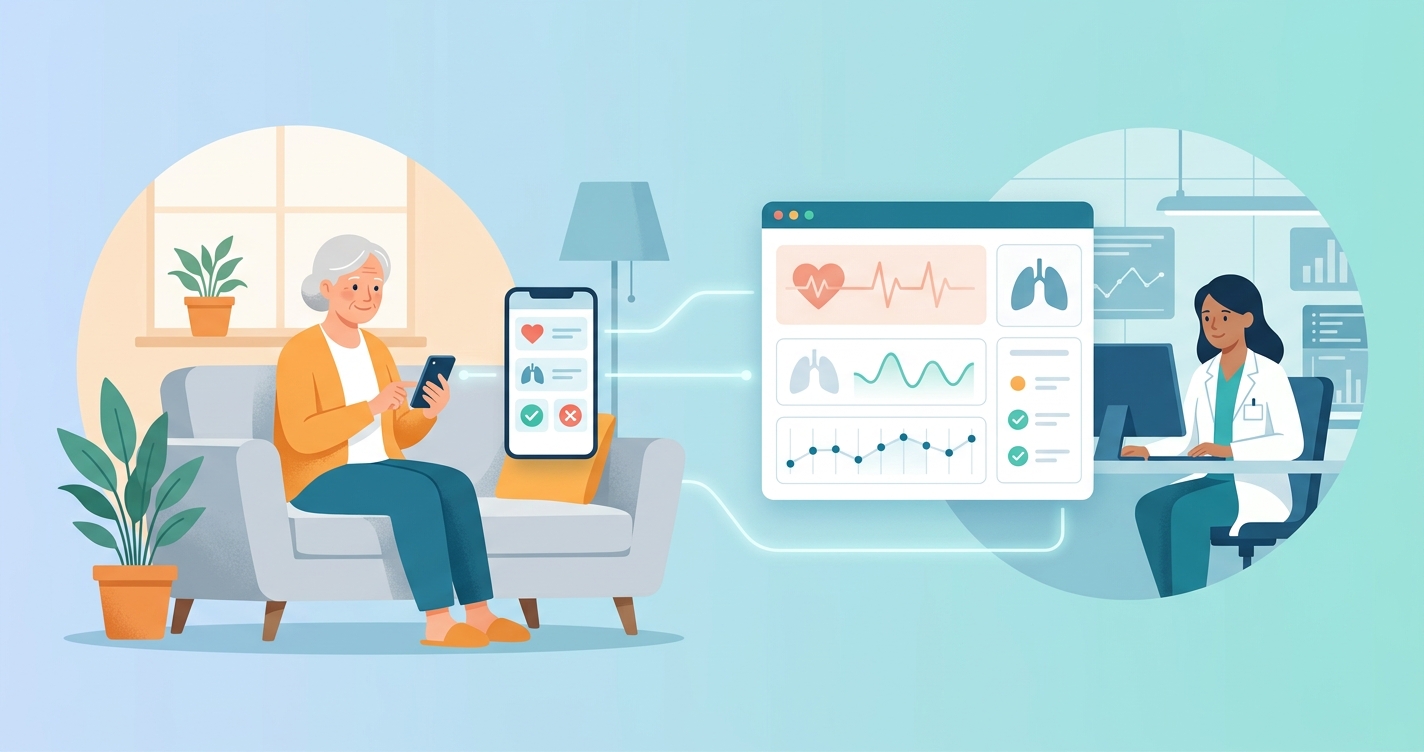
Monitoring only helps if patients actually participate. That is why low-friction check-ins matter. Depending on the program, that may include symptom prompts, pulse oximetry, blood pressure, weight, or camera-based vital sign capture. The point is to create signal without piling on device fatigue.
3. Triage based on trend change, not static risk alone
A heart failure patient is high risk on paper. A heart failure patient with a rising respiratory rate, worsening resting heart rate, and two missed check-ins is high risk today. Those are different operational categories, and good post-discharge monitoring separates them.
4. A response path that stays inside routine care operations
When monitoring flags a problem, the next move has to be simple: nurse outreach, same-day telehealth, medication review, urgent clinic slot, or escalation to higher-acuity care. If the workflow stops at "alert generated," the program will not change outcomes.
Why daily vitals trends are more useful than one-time readings
Many readmissions are preceded by small changes that do not look dramatic in isolation. A slight rise in respiratory rate. A steady climb in resting heart rate. Lower activity, worse sleep, missed check-ins, vague shortness of breath. These are not always admission-level findings. They are often the earliest clues that a patient is moving in the wrong direction.
That is why trend monitoring matters more than snapshot monitoring in the discharge period. A single number may reassure or alarm without context. A sequence of daily readings gives care managers something more valuable: direction.
For chronic care buyers, the most useful monitoring signals after discharge often include:
- Respiratory rate trend changes
- Resting heart rate changes from personal baseline
- Heart rate variability shifts that suggest physiologic stress
- Adherence to daily check-ins
- Symptom changes paired with vital sign drift
This is also where contactless models make sense. If a patient can complete a brief camera-based check-in on a phone or tablet they already own, the odds of sustained participation may be better than in programs that require another wearable, charger, sync step, or replacement shipment.
Readers evaluating adjacent chronic care workflows may also want to see our analysis of how ACOs monitor high-risk patients between visits and how to reduce hospital readmissions for chronic disease patients.
Current research and evidence
Several findings are especially relevant for teams trying to prevent 30-day readmissions after discharge:
- Stephen F. Jencks, Mark V. Williams, and Eric A. Coleman reported in NEJM in 2009 that nearly 20 percent of Medicare beneficiaries were rehospitalized within 30 days, putting a hard number on the transition-of-care problem.
- Kathryn Feltner and colleagues found in Annals of Internal Medicine in 2014 that home visiting and multidisciplinary heart failure clinic interventions reduced all-cause readmissions for heart failure patients.
- A 2024 systematic review and meta-analysis of outpatient follow-up visits reported a pooled adjusted effect estimate of 0.79, or about a 21 percent lower risk of 30-day all-cause readmission overall.
- CMS continues to use 30-day readmission measures for heart failure and COPD in the FY 2025 Hospital Readmissions Reduction Program, with penalties up to 3 percent for excess readmissions.
- A 2023 accountable care study of post-hospitalization remote monitoring in heart failure and COPD suggested that monitoring can improve some post-discharge outcomes, but only when it is embedded in a real care management model rather than treated as passive data collection.
The pattern across these sources is pretty consistent. The organizations that reduce readmissions do not just discharge patients better. They stay connected longer and respond faster.
The future of post-discharge monitoring
The next phase of post-discharge monitoring will probably look less like a standalone RPM pilot and more like a built-in transitional care layer for chronic disease operations.
Three changes seem likely.
Monitoring will become more baseline-aware
Programs will rely less on universal thresholds and more on changes from each patient's recent baseline. That matters because the patient whose respiratory rate rises from 14 to 20 may need attention before the patient who simply posts a borderline reading once.
Transitional care and chronic care programs will converge
The handoff from discharge team to chronic care team is still messy in many organizations. Over time, the best programs will treat the first 30 days after discharge as part of the chronic care continuum, not as a disconnected episode.
Lower-friction capture will matter more than hardware volume
There is no shortage of sensors. What many programs still lack is reliable participation. Simpler workflows that patients actually complete every day are likely to outperform more elaborate setups with weak adherence.
Frequently asked questions
What is post-discharge monitoring?
Post-discharge monitoring is the process of tracking a patient's status after they leave the hospital so clinicians can identify deterioration early. It usually combines follow-up outreach, symptom review, medication checks, and vital sign monitoring during the first 30 days.
How does post-discharge monitoring help prevent 30-day readmissions?
It gives care teams earlier visibility into worsening symptoms or vital sign trends. That makes it easier to intervene with a nurse call, medication adjustment, urgent clinic visit, or telehealth follow-up before the patient needs emergency or inpatient care.
Which patients should be monitored most closely after discharge?
Heart failure patients, COPD patients, older adults with multiple chronic conditions, and patients with recent prior utilization are usually the top priority groups. These populations are more likely to deteriorate quickly once they return home.
Why are daily vitals useful after hospital discharge?
Daily vitals provide trend data rather than isolated snapshots. Trend changes in respiratory rate, heart rate, or adherence can reveal trouble earlier than scheduled follow-up alone.
Preventing readmissions is not just about a better discharge packet. It is about giving care teams enough visibility in the days after discharge to catch small problems before they become expensive ones. That is exactly why chronic care programs are paying more attention to lower-friction monitoring models. Solutions like Circadify's chronic care management approach fit that shift by helping organizations capture repeat patient check-ins without adding another device-heavy workflow.